

I found a video I made in April 2020.
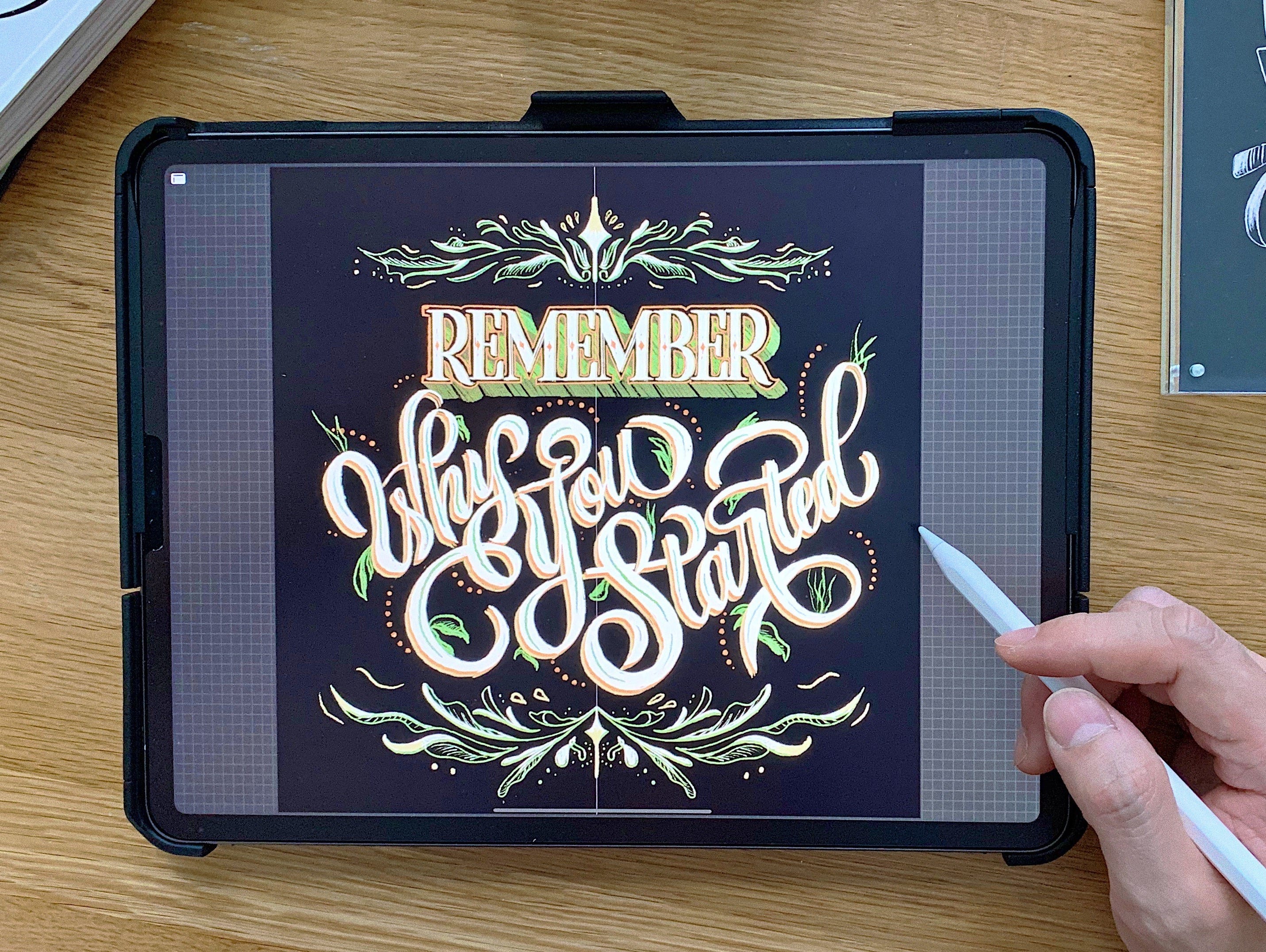
It’s sitting on a YouTube channel I stopped updating years ago, and in it I’m working through why lettering had stopped being fun. Lettering was my craft first and my business second.
About three and a half minutes in, I say this:
“When your passion becomes a business, it becomes hard to delineate passion and business. When you’re too focused on getting clients, you just forget what it means to you.”
Then, from 2021 onwards, I stopped lettering. Period. Five years.
So the sentence was right about what had happened. It’s a much worse description of what I then did with it.
I’m building something out of a thing I care about again now, which is why I went looking for that video in the first place.
It was COVID.
Nobody was buying anything, and nobody was paying for a service that wasn’t essential. A chalkboard menu for a café is about as non-essential as it gets.
“It’s the first line on the invoice to go.”
I’d also spent the months just before that trying to turn it into something I could do full-time. So the timing was almost funny. I had committed harder than I ever had, and then the market for it closed.
I kept trying to make everything work anyway, and nobody was spending, and eventually I burned out.
“Maybe the same effort would pay off now. I’ll never know.”
That’s the state I was in when I worked out that passion and business don’t mix.
Five years later I still had the sentence. I’d completely lost the April it came out of.
I suspect a lot of people are carrying something from that stretch in particular. Decisions about what kind of work is safe, and about how much risk you can personally stand.
Those were sensible readings of a period when nothing was steady. And a fair few of them have been running ever since inside a period that isn’t that one.
It isn’t only 2020, though. Most of what we know about ourselves was worked out somewhere in particular. I don’t handle uncertainty well started somewhere. I’m not built for that kind of work started somewhere.
They’re hard to argue with because they arrived with evidence. You were there. You watched it happen to you.
And something that came out of your own experience doesn’t feel like a view you’re holding. It feels like self-knowledge, which is supposed to be the reliable kind.
I want to be careful here, because the easy version of this is that was the old you, and that isn’t what I mean, and it isn’t always true.
Sometimes you go back and check and it still holds. You find that what you worked out about yourself years ago is still accurate, and knowing that with any confidence is worth a great deal. That’s a real answer.
The narrower point is just that it should have to prove itself again, rather than standing because nobody ever went back to look at it.
So, a small thing to do with this.
Take something you’d say about yourself in the flat voice you’d use for a fact, and ask when you decided it. There’s almost always a period, a season of your life where it made sense.
Then ask what was true about you then that isn’t true now.
Mine was right in April 2020. I let that be right about the next five years as well.
Nate Ong writes Honest to Greatness from Singapore - essays on the decisions that loop, the systems that shape them, and what they’re trying to tell you before you force an answer.
He also coaches, mostly senior people in tech working through questions they’ve been carrying for a while. ICF trained.
More at nateong.com, including the free 7-Day Honest Check-In (one question a day, by email) or a way to book a conversation.