

Growing up, more was always the answer.
More money meant more flexibility.
More credentials meant more doors.
More knowledge meant more confidence.
Every adult I trusted seemed to be pointing in the same direction. Build the cushion. Keep the doors open. Don’t put yourself in a position where you have to commit before you’re ready.
By the time I was old enough to have my own opinions, the principle that “more is better” had stopped feeling like a suggestion and started feeling like bible.
I built my career around it without noticing. The steady day job income, the title, the years of seniority.
All of it real, all of it earned.
It paid the bills, and it paid for the side hustles I was making, and that combination was what let me tell myself I was being responsible; practical even.
What I was actually doing was using the safety net to defer my decisions. Every move I made on the side felt optional because the cushion of a day job was always there to absorb the cost of not fully committing.
It was hedging, and it was working exactly as hedging is designed to work. It would take starting to build something with my own hands, in a job I couldn’t move out of, to notice that:
The cushion wasn’t keeping me safe. It was keeping me asleep.
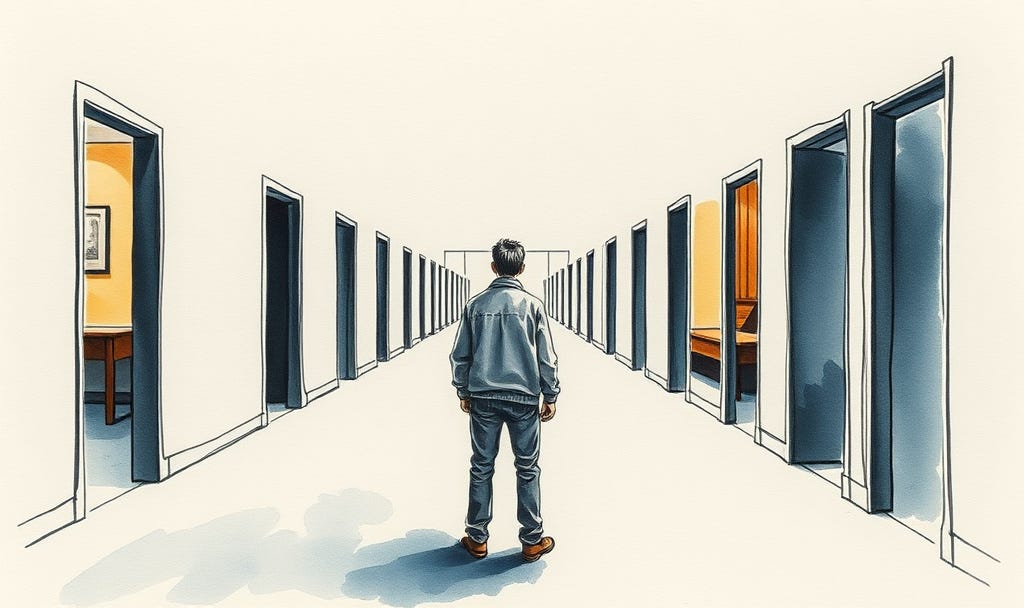
It took me years to notice that the strategy had a quiet cost.
The seasons of my life when I felt most alive, most creative, most like the person I actually was, were the seasons I was building something that was mine. The work in front of me was work I’d chosen to start. With my own hands, on my own time, in the moments between everything I had to do.
The corner I got nudged into didn’t produce the aliveness in me. Building something did. Looking back, I can identify when this hit me, even though at the time it didn’t feel like a lesson. It felt like failure.
I was working in IT, in a stable job, with a reasonable salary. Money wasn’t the problem. The problem was that I had stopped wanting to do the work, and every effort I’d made to move elsewhere and into something I actually wanted had failed.
I applied to the kinds of roles I thought would be a better fit. I got nowhere. I networked, I updated my CV, I tried the soft pivots that were supposed to be easy. None of it worked.
My corner wasn’t dramatic. The salary was fine. Nothing was burning. The front door I’d been hoping would open quietly was just closed and not negotiating. I could have just stayed in the role I had and leave it at that. Sure, it was comfortable enough to live, but it was uncomfortable enough to slowly stop being myself. That turned out to be enough to finally make a move.
I started doing the only thing left that was mine to start. I picked up a piece of chalk, and built Designate Studio out of the corner I was in.
For at least thirty minutes a day after work, mostly on whatever surface I had, I held a pen or a chalk. I would practice relentlessly, drawing each letter until I got tired. The first paid gig was a barter with a cafe. They let me letter their menu boards in exchange for the kind of exposure I actually needed at that point. None of that was strategic. It was the only thing left to do. I told myself I had no choice, but to go. The doors I’d wanted to walk through wouldn’t open, so I made a side door of my own. It was never easy.
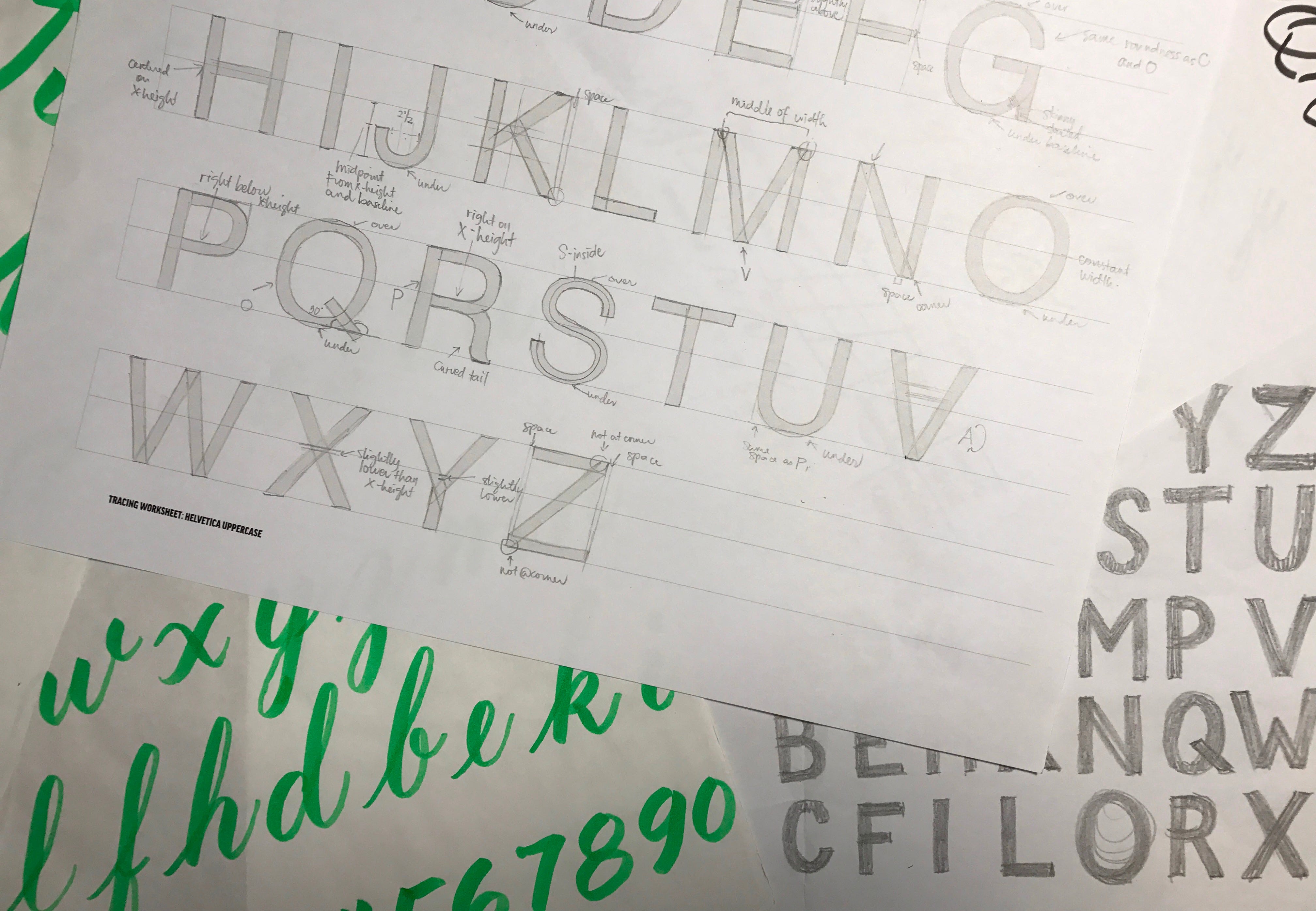
I look back at that period now and what I notice isn’t the difficulty. It’s the speed. I was learning faster than I have at any point since. I was making moves I would never have made if there had been an easier path available to me. The constraints didn’t slow the work down. They were the ones producing the creativity.
Chalk taught me something I didn’t have words for at the time.
The humble chalk is a simple tool, but it can be an instrument for a masterful piece.
You can do so much with chalk. The dust itself, the sharp lines, the blunt strokes. The whole vocabulary of the medium lives inside one small piece of compressed pigment. Nothing about it suggests it should be capable of what it is. This constraint is what actually gives it the range of possibilities.
Stravinsky said it cleanly almost a century ago:
“The more constraints one imposes, the more one frees one’s self.”
Take the constraints away and what you usually get isn’t freedom. It’s paralysis.
Austin Kleon, in plainer words: “Nothing is more paralyzing than the idea of limitless possibilities.”
If you have ever sat in front of a blank page and felt your mind go strangely flat, you know exactly what they’re describing. The infinite version of any task is harder than the constrained version.
Tell me to write anything I want and I will write nothing.
Tell me to write a six-word story and I will hand you something within an hour.
The corner doesn’t have to be a closed door. Sometimes it’s a thousand defensible reasons. The trap is the same shape, and smart people fall into the second kind harder than anyone else.
More knowledge is supposed to lead to better, smarter decisions. The more you know about your industry, your options, the people you’d be working with, the cleaner the choice should get.
In practice, it goes the other way.
The people stuck in big life decisions usually have all the information they need. They have too much of it. Every option has a defensible argument against it, and the defensibility is what locks them in place.
The corner they need is recognizing that
they feel shit about not moving anywhere.
Most senior people I work with have spent their entire adult arc removing every kind of corner.
More savings, more titles, more doors, more fallbacks, and more frameworks.
By every measurable definition, they should be feeling freer than they ever have. But what they describe is the opposite. A sense of flatness. The creativity they used to have, they can’t quite locate now. The cushion they built so carefully over the years is the very thing that either either dulls their senses or keeps them up at night.
I think this is why people in quarter or midlife crises so often do something that, from the outside, looks like a mistake. Whether it’s dramatic, like quitting the secure job or selling the house; or much quieter, where they start something on the side that most people think is not who they are. But from inside the person making the move, it often feels like the first honest decision in a decade.
The suggestion isn’t to burn the cushion or quit the job. It’s smaller and much harder.
Stop giving yourself an out from every decision.
And when life backs you into a corner anyway, notice it before you rationalize, and avoid the move you’re already being asked to make.
This is what coaching does, on a small scale, when it works. Most rooms and situations in adult life are designed to let you not commit. The room I work in isn’t. You don’t have to walk in with the answer. You just can’t walk out without having actually looked for it. Almost nothing else in your adult life is set up to ask that of you.
I used to think the goal was to keep adding options until I felt safe enough to move. That was backwards. Options were not going to make me safer. They were going to keep me from finding out what I’d do without them.
The version of me that I trust most isn’t the one with the most cushion or the most knowledge.
The one I trust most is the one in the corner with the chalk and thirty minutes a day. He had almost no information that mattered. Just one piece that did: he couldn’t keep doing what he was doing. That was the only knowledge sharp enough to move him.
The lettering business eventually didn’t last. That also isn’t the point. The move was the gift. And it’s a move I’ve made twice now. The first time, a closed door pushed me into chalk. The second time, years later, a different door of the same shape pushed me here, into the work I do now. Both times, the corner held me in place long enough to start building something that was mine.
That’s the trade you keep optimizing away. And it’s the only one worth keeping.
Nate Ong writes Honest to Greatness from Singapore - essays on the decisions that loop, the systems that shape them, and what they’re trying to tell you before you force an answer.
He also coaches, mostly senior people in tech working through questions they’ve been carrying for a while. ICF trained.
More at nateong.com, including the Energy Assessment (a free 5-minute check on what’s actually fueling and draining you) or a way to book a conversation.
'The cushion wasn’t keeping me safe. It was keeping me asleep.' That line really hit me. It is so easy to stay comfortable and let too many open doors make it harder to move forward. Your story is a great reminder that being stuck in a corner can force us to stop delaying and finally build something that is truly ours. Thankuuu nate for sharing such a masterpiece 🤍✨